Note: for longtime Bibliophilopolis readers & subscribers, I am using my blog for another one-off (two-off?) non-literary post here so that it can be shared with the Indiana State Chess Association’s website/blog. I do hope to return to writing about books and short stories someday soon, however.
Photo credit (also ALL other photos credit 🙂 ): Summit Chess Club
This year, National Chess Day fell right in the middle of the ongoing U.S. Chess Championship and U.S. Women’s Chess Championship. Those events “celebrated” by taking a day off from the tournament with one of the event’s two rest days. Here in Indiana, we actually PLAY chess to celebrate National Chess Day!
Hosted by Carmel’s Summit Chess Club, the National Chess Day Open attracted a whopping 99 players (an exceptional number for a one day event in Indiana!) across all its sections. Beginning with a scholastic event in the morning, which included many of the 16 new USCF members(!) across all sections – and children as young as 5 years old – and wrapping up with an Open event in the afternoon/early evening featuring several of Indiana’s titled (Masters or Experts) players including a 2-time state champion, Braydon Povinelli (who was accompanied by Indiana University’s chess team, which largely dominated the top section of the open). Reigning Indiana Reserve Champion, Ben Foley, was also among the participants, as were Indiana’s two highest-rated female players, Madison Brown and Laura Alejandra Escobar Lopez. (They were among 14 female players overall – still not the ideal ratio we’d like to see – but getting better!) The actual winner of the event was, of course, “None of the Above” as young Alexander Smith – part of the IU contingent, finished in sole first with 3.5/4, with only a last round draw vs. Povinelli preventing a perfect score.
Aleander Smith – winner of the Open
In the Reserve (U1800) section, Akinola Olufumilayo (still with a provisional rating!) and Hayden Nelson of Indiana were joined by Dylan Wzorek of Illinois in a three-way tie for first, all with 3-1 scores.
Akinola Olufumilayo – tie for first in the Reserve Section!
While in the Novice, Dax Bills increased his provisional rating by over 100 points in garnering a perfect 4-0 result. Winners in the scholastic event were:
12th and under: Benjamin Joseph, Hunter Broomall, Henry Alton Liu (3 way tie for 1st place)
12th & Under Prizewinners
6th and under: Nash Harper Winckelbach
6th & Under Prizewinners
3rd and under: Abhiram Ashok
3rd & Under Prizewinners
This was the Summit Chess Club’s largest event thus far. Just founded this year as a 501c corp by Nikhil Murugan ,who is a student at Carmel High School. As you see on the photo above, the Club’s tagline or motto is “Win or Learn” from a quotation that many of us chessplayers are familiar with.
Some tournament stats in a nutshell:
99 players 6 sections 13 First time OTB players 14 girl participants 7 Students from Indiana University
The Indiana University chess club – look for them this coming weekend at the ISCA Team Championship!
Oldest player: Jack G Heller Youngest Player: Isha Arun (5 years old) Pictured below
Highest rated player: Braydon Povinelli (National Master & two times Indiana State Champion) 2 Experts: Jay A Carr & Nathaniel Criss 2 Top Indiana Girls: Madison Brown & Laura Alejandra Escobar Lopez
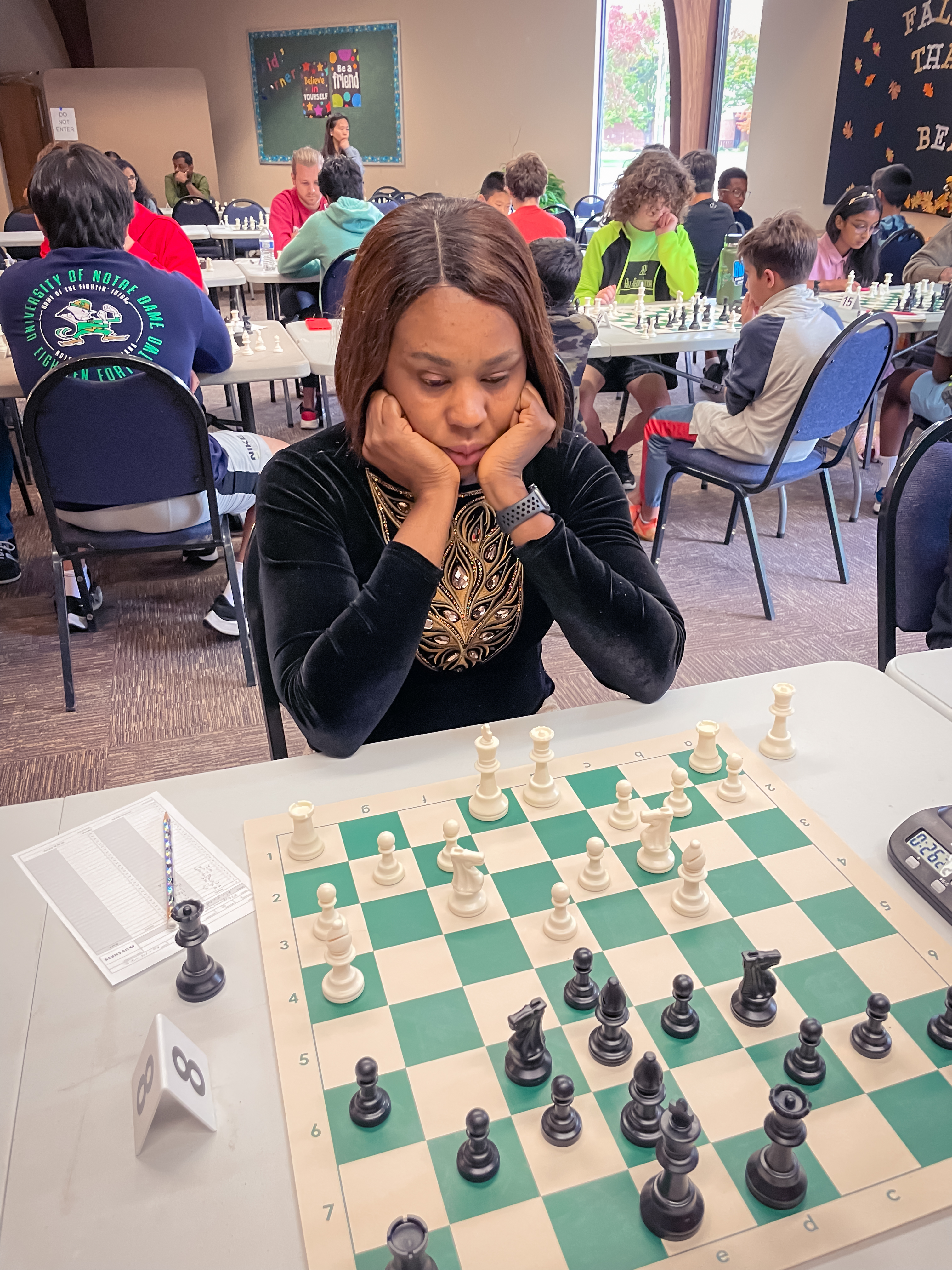
Foreground: Alexander Smith vs. Madison Brown; Background: Lauro Alejandra Escobar Lopez vs. Josh Smith
Players from IL (4), OH, TX and IN (Fort Wayne, Bloomington, Kokomo, DeMotte) Several siblings & all 4 kids in one family participated Father/Son – Gabriel Adam Hawkins / John Martin Hawkins
Summit Chess Club plans to make this an annual event so look for it again next year – and their other events in the meantime! Hope everyone enjoyed their National Chess Day as much as we did!
The Suit: For Deal Me In 2023, ♦♦♦Diamonds♦♦♦ is my suit for short biographies of Indiana Governors and their first ladies. (No, sadly Indiana is yet to elect a woman governor)
The Authors: Ronald J. Allman II (from Governors of Indiana book) and Margaret Moore Post (from First Ladies of Indiana and The Governors book). Allman is an Associate Professor of Journalism at Indiana University Southeast and Post was an accomplished journalist whose career began in Louisiana covering the notorious Huey Long. Read more about Margaret Moore Post here.
The “Story”: Edgar Doud Whitcomb, the 43rd Governor of Indiana and his wife, Patricia Dolfuss Holcomb
Governor Edgar Whitcomb
“Whitcomb escaped from a Japanese prison on May 22, 1942, by swimming eight miles in shark-infested waters between Corregidor and the mainland of the Philippines.”
I was probably eight years old or so the first time I was old enough to answer the question, “Who’s the Governor of Indiana?” And the answer to that question was “Governor Whitcomb!” Admittedly I only possessed this knowledge as a ‘fact in a vacuum’ and probably had very little idea of what a Governor was other than him being the leader of our state. A few years back I bought a book of brief biographies of all the Indiana governors, edited by Linda C. Gugin and James E. St. Clair, who I also had the pleasure of meeting just this past December at the Indiana Historical Society’s annual Holiday Author Fair, featuring scores of Indiana authors.
Whitcomb was a World War 2 veteran who also spent time as a P.O.W held by the Japanese, escaping twice(!) and even wrote a book about his experiences, titled “Escape from Corregidor.” After his escape, he fought with the Philippine Resistance. In short, it seems like he was a real badass.
As governor he had the misfortune of – despite being a member of the party which held large majorities in the state congress – presiding over the state when his party was embroiled in internal strife, making it hard to achieve some of his intended legislation. One thing he held the line on, however, was his promise not to raise taxes (gotta admire an elected official who can do that!).
In his retirement, he lived in a cabin in the Hoosier National Forest and later near the Ohio River, finding peace in solitude which I found enviable.
Below: There is a bust of Whitcomb in the Indiana State House (less than a mile from Bibliophilopolis Headquarters in downtown Indianapolis!) and, before launching Deal Me in 2023, I took pictures of it and those of several other governors who may appear later in the year in this blog.
Patricia Dolfuss Whitcomb was described as “a glamorous brunette beauty” who met Edgar when she was working modeling in a tearoom in an Indianapolis department store (probably the famous L.S. Ayres tea room?). Along with the Governor she raised five children yet still found time to support many worthy causes and was also a much sought after ‘guest of honor’ at local events. She was also an ‘amateur’ fashion designer and once, when a gown of her own making was complimented by the press leading them to ask who the designer was, she said, “Hoosier.”
UPDATE: Bibliophilopolis readers are the best! Upon reading this post, one of them – who worked for many years in the Indiana Statehouse – said that I reminded him that he had bought the Edgar Whitcomb book at a garage sale, and he sent me a couple pictures. Thanks, Geoff!
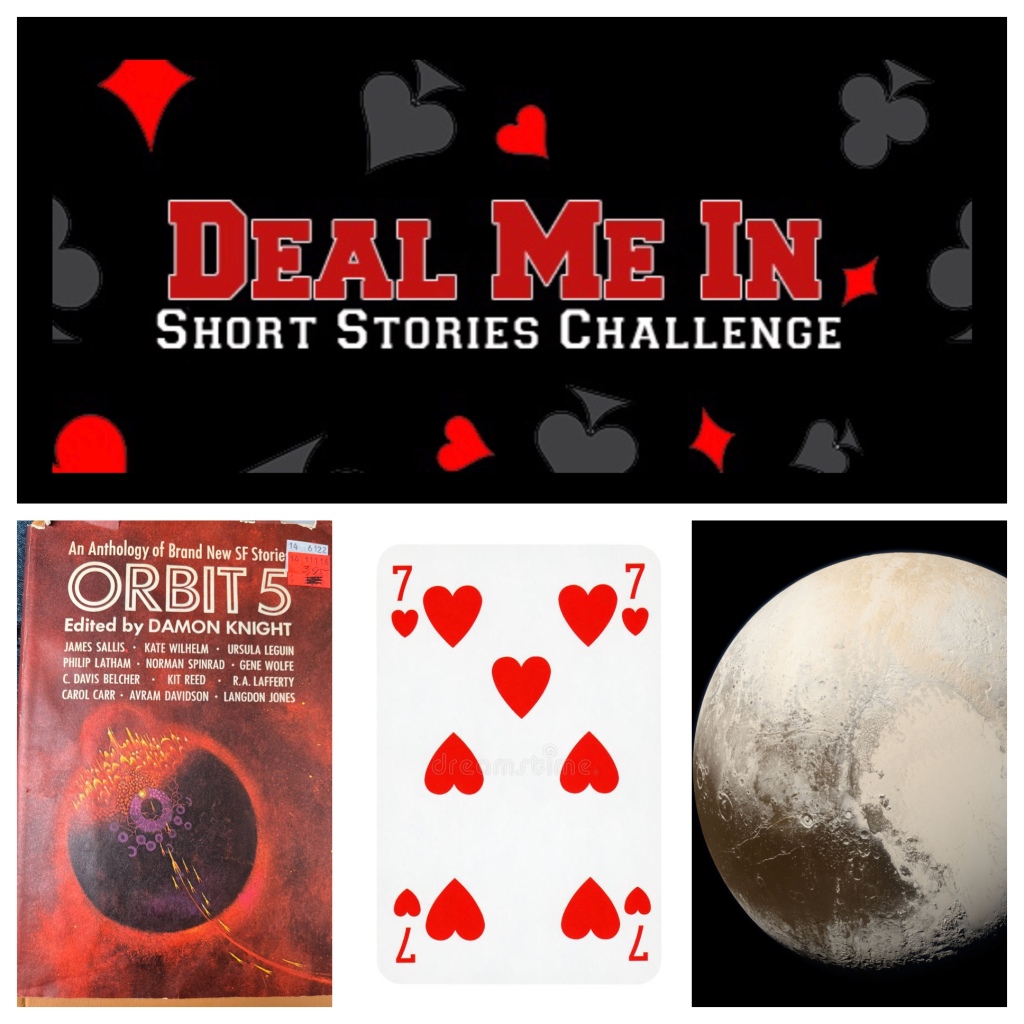
The Suit: For Deal Me In 2023, Hearts is my suit for stories from the Sci-Fi anthology, “Orbit 5,” which I purchased at the local Benton House’s annual book sale fundraiser.
The Author: Philip Latham – Actually the nom de plume of real life astronomer, Robert Shirley Richardson. Unbeknownst to me when picking my stories for 2023, he’s a fellow Hoosier, born in Kokomo, Indiana in 1902. He also wrote two “Children’s Sci-Fi” novels (I didn’t even realize this was a genre!)
The Story: “The Rose Bowl-Pluto Hypothesis” from the Orbit 5 anthology of science fiction stories, published in 1969.
Are you (like me) one who is interested in the origin stories of works of fiction? That’s one of the things I like about a good anthology – they often have an appendix or chapter with short bios of the authors or even a short explanation of how they came to write their particular contribution to the anthology. That’s why the annual Best American Short Stories volumes are among my favorites. They have great background info. Alas, when I leafed through the Orbit 5 anthology, however, there was none of this background info, BUT, in reading the story myself, I think I can infer something of its origin…
The Rose Bowl-Pluto Hypothesis
“Now, for the first time, he was becoming aware of the awful majesty with which the heavenly bodies went through their motions, enacting a drama the minutest detail of which was inevitable from the beginning.“
Mr. Zinner and Mr. Alyson are professors of, respectively, Physics and Literature at – I assume – a California university. We meet them as they’re spectating a track meet at the Rose Bowl. Zinner is questioning why records in the 100-yard dash – or the mile for that matter – are continuing to get faster and faster. Alyson suggests that there is only one explanation for this fact: ‘The track men today are better than we were forty years ago.‘ Zinner dismisses this and reveals his own shocking theory: ‘…the hundred yards of today are not the hundred yards of yesterday… because space is not the same. It’s shrunk.’ (I did say it was a shocking theory)
Zinner goes on to explain how measurements of the speed of light over the history of scientific inquiry (see here for a brief history) have been inconsistent, with the velocity of light “taking a slump” every now and then. It is in his explanation to his more literary colleague that the potential origin is revealed. He describes an early attempt by Galileo to measure the speed of light (the first such experiment we know of in recorded history). Galileo has an assistant take one lantern a great (but known) distance away. The lanterns have a shutter and Galileo directs his assistant to raise the shutter of his lantern the instant he sees the light from Galileo’s lantern when Galileo raises his shutter. Galileo reasoned that he could time the interval between his revealing light from his lantern and his subsequent observation of his assistant’s lantern. It didn’t work. The speed of light is too fast to be measured in such a way at such short distances (great idea, though, huh?). His only conclusion was that the speed of light it must be very fast indeed.
Latham takes some liberties with the Galileo story to make his own short story more interesting, but what I loved about the story is that, to my imagination at least, the light from those lanterns shone roughly 300 years into the future to spark the idea for this short story. Researching the author and finding out he was an astronomer himself added more appeal to this origin.
So, just a little short story in a >50-year old anthology sparked a lot of thinking and learning on my part. Now that’s a short story that has done its job!
The story ends with the following lines from John Donne’s poem “Go and catch a falling star”:
Go and catch a falling star,
Get with child a mandrake root,
Tell me where all past years are,
Or who cleft the devil’s foot,
Galileo pic found at wondersofphysics,comPicture if you will…
Trivia Addendum: E=mc2… We all learned this formula in school right? (or at least from watching the intro to episodes of The Twilight Zone!) But why does the letter “C” represent velocity (the speed of light in this case)? You may know that the word “celerity” means ‘rapidity of motion or action’ which comes from the Latin word, “celeritas” which was Galileo’s conclusion about the speed of light after his lantern experiment.
Note: for longtime Bibliophilopolis readers & subscribers, I am using my blog for a one-off non-literary post here so that it can be shared with the Indiana State Chess Association’s website/blog. I do hope to return to writing about books and short stories someday soon, however. Don’t give up on me yet!
The Beginning
I am writing this dispatch from the center of Reykjavik, Iceland just the day after the annual Reykjavik Open has ended. This year’s event shattered the existing record for number of participants and – thanks to the help of an Indiana delegation of three (as ISCA President Lester VanMeter pointed out) – the tournament even broke the 400 mark with 401 total entries. Without us, they could only boast of 398 entries, right? 😊
The Delegation
I decided back in November 2022 to make my third trip to Iceland for this great event and, perhaps due to my incessant talking about my past experiences in Reykjavik in chess circles, my friend and chess colleague Bob Banta (fresh among the ranks of us retired folks) decided he would go also. The aforementioned Lester VanMeter hinted he might go too and eventually he became the third when he officially registered for the event. We were also unofficially counting Michael Carey (currently of Rhode Island) as an honorary member of the delegation as he is a longtime friend of Lester, who first met him in Troy, NY, when he (Lester) was a student at RPI. None of us were sporting particularly impressive FIDE ratings heading into the event and for the most part we confirmed their accuracy😊.
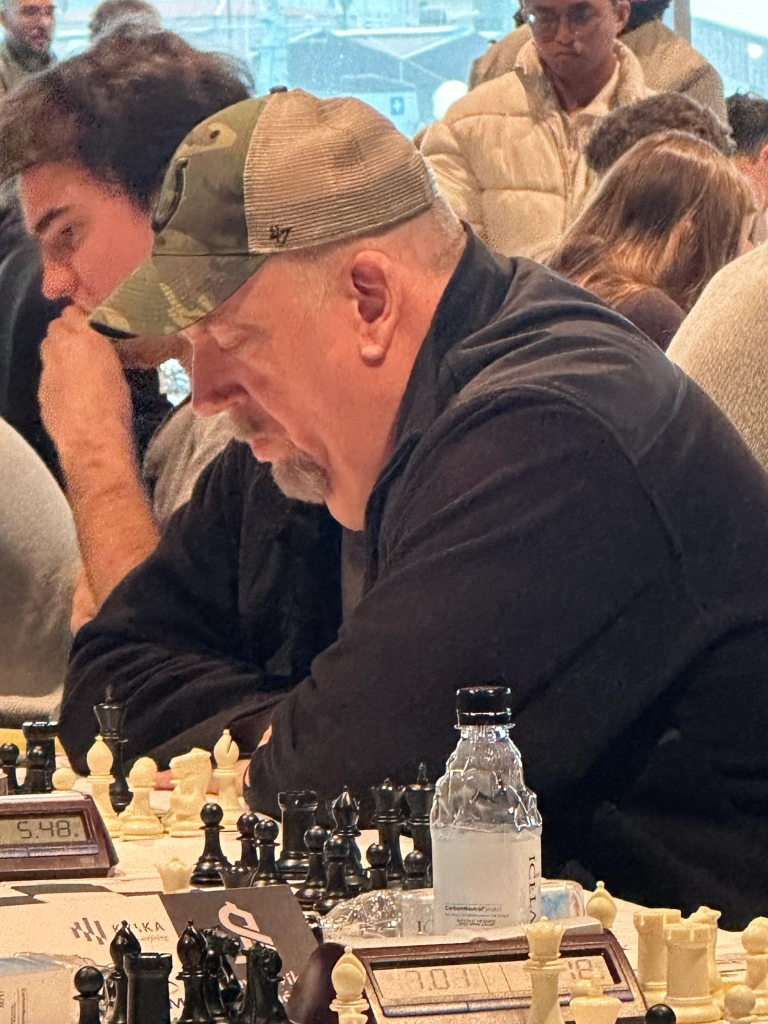
Lester at the Board
Bob at the, er, Bobby Fischer Center
Hey, that’s me at the board!
Mike at the “Split Rock” social protest memorial
The Preparations
How does one prepare for any tournament is a tough enough question, but a big, international event like this makes one feel like serious preparation is required. So, I played a lot of chess in early 2023 around Indy, and even played a FIDE rated event in Dallas in February as my “dress rehearsal” for Reykjavik. My results in Dallas were abominable, so I had to cling to the old show biz adage that if the dress rehearsal goes badly, the actual performance will be a success! (Chess players are great at rationalization!). Just before leaving for Iceland, though, I had two consecutive good results in local tournaments, gaining 44 USCF rating points in the process and at least getting some of my confidence back after spending most of my recent chess time sitting on my rating floor of 2000. The first time I went to the Reykjavik Open in 2017 was also after a period of relative success in USCF events, boosting my rating to 2086 at that time – a level where I was ‘less ashamed’ to show my face at an international event (later I learned & reminded myself that nobody cares).
So, playing was my main preparation, but I’d also been reviewing my new opening ‘repertoire’ that I’ve been trying to put into place in recent months. Lastly, on the Sunday before our departure, Lester hosted an ad hoc training tournament at his house, recruiting strong – though largely inactive in recent years – master Nick Adams of Fort Wayne to join the three of us in a double round-robin of rapid games (about an hour each). This provided a final boost of practice and some additional confidence for me, and we were ready to take the plunge. A few pics from our training tournament below.
Arrival
I learned my lesson after my first trip here to give yourself some time to settle in before you have to start playing chess. In 2017, I arrived at 7:40 in the morning and then had to sit at the board less than six hours later – not the best recipe for success! As I told Lester before we left “I didn’t know what the hell I was doing that first trip!” So, this year I arrived >48 hours ahead of kickoff as did Lester, while Bob arrived >24 hours and got in a ‘Walking Food Tour’ of Reykjavik, while I spent the day on a tour of the Southern Coast of Iceland, as weather deteriorated rapidly, eventually featuring >100kph sustained winds. People in my tour group were literally being BLOWN OVER by the wind and started walking with arms interlocked at the elbows. At one point, near the town of Vik, I was swinging my backpack over my shoulder to put it on and the wind caught its broad surface and treated it like a kite, trying to tug me across the famous black sand and into the sea (which WAS angry that day, my friends. Very. Angry). I remember thinking, “And I paid to be on this tour!”
Opening Party & Playing Location
Reykjavik’s stunning Harpa Concert Hall and Conference Center (above) has in recent years taken over as the playing site for this storied tournament (which has been held since 1964 – a nearly 60 year run!). Situated right on the shore of Reykjavik’s harbor on the Sea of Greenland, it’s my favorite place of all the tournaments I’ve ever played in. With this year’s record number of entries, we were a bit more cramped than in prior years. The Indiana contingent often joked amongst ourselves about scoring well enough to stay out of the ’steerage’ section of the lower boards. The lowest boards were down a short hallway with the sea ‘just outside ‘ the wincows. A Dutch player, Eric de Winter (who I’ve gotten to know over my prior visits), was having a bad tournament and quipped to me that he kept dropping to lower and lower boards and feared by the last round he’d “be in the water!” Funny all the things we chessplayers find to keep ourselves entertained during a competition.
Below: The lowest boards of the ‘steerage’ section.
On the eve of the tournament, there was an opening party for the registered players. I was the only one of our group who attended, but ran into a few familiar faces, including FM Todd Andrews, who I didn’t recognize at first, and Craig Jones. Todd said, “Aren’t you from Indiana? I think we’ve played…” When he said his name, I remembered that we’d played in the 2005 Louisville Open.
I also met a German player, Gerd Densing, who told me of a multi-year project he’d been working on – getting autographs of players whose games are featured in the studies in the great book, “Perfect Your Chess” he’d accumulated over 250 so far and hoped to add a couple more at this tournament. Interesting idea! I didn’t stay that long at the party though as I was still jet-lagged and wanted to at least try to get some sleep before we began play the next day.
Tournament Peculiarities
After playing a lot of smaller swisses lately, I’d gotten used to ‘never’ knowing what color I would have for a particular round, in a tournament with 400 players, though, the pool of potential opponents is usually so large that having to play the same color in consecutive games is a rarity, and indeed none of the Indiana contingent got the same color twice in a row. Another feature was that the white pieces were on the same side of the board throughout the entire playing hall – the player playing white would always be facing west. I started my tournament with black while Bob and Lester started with white, meaning we would be facing opposite directions, and they were usually in my range of vision. This last factor meant that I could not employ one of my many superstitions. In tournaments where one gets to pick which side of the table to sit at, I always keep facing the same direction if I’m winning and change directions if I’m losing.
Scenic skittles area:
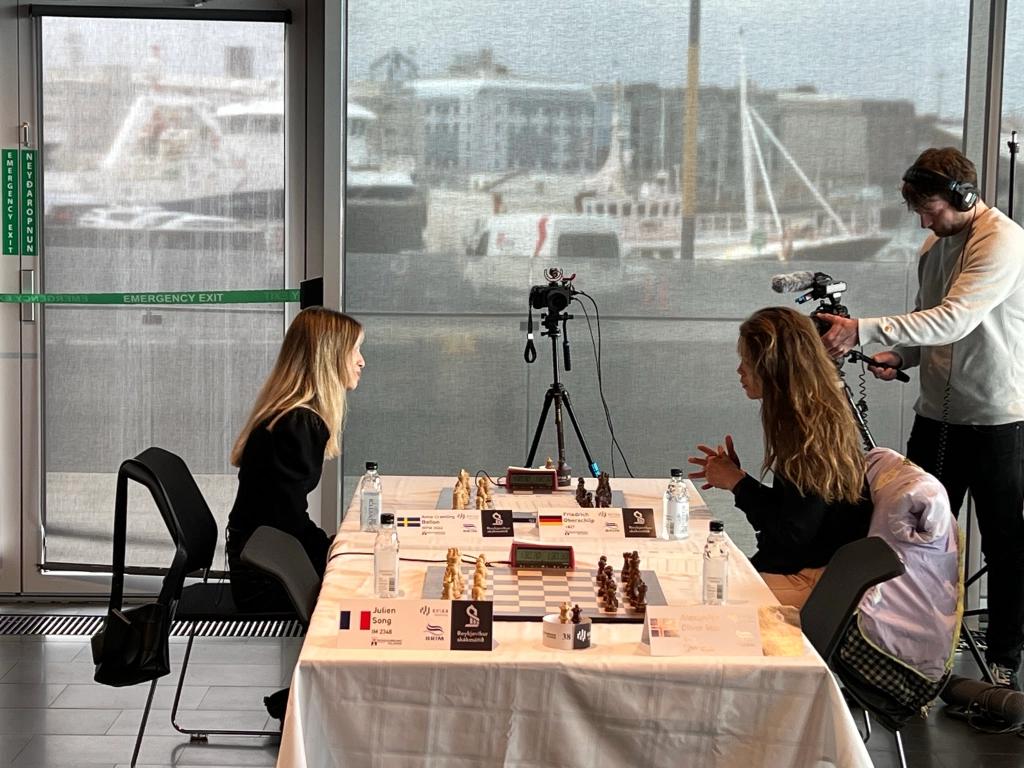
There was also a “Streamers Corner” section of the playing hall where chess streaming ‘celebrities’ played their games regardless of their score in the tournament. This section included some extra space for cameras, wiring, etc. Names you might recognize are Alexandra Botez, Simon Williams, Anna Cramling (pictured below being interviewed by local television), Dina Belenkaya and Eric Rosen.
The Results
Well, Mike actually led the way from our group with a last round win putting him at 4.5/9. The rest of us followed closely. I only drew the last round and finished on 4/9 and Lester and Bob each settled on 3.5/9. As for the tournament as a whole, Swedish Grandmaster Nils Grandelius finished in sole first place with an impressive 7.5/9 “finally” winning the event on his eleventh attempt. Indonesian IM Irine Sukandar won the top women’s prize (with 6/9) on tiebreaks over German WGM Sarah Papp and Indian IM Nisha Mohota.
Turkish GM Mustafa Yilmaz (L) and Grandelius (R)Women’s winners (L-R) Papp, Sukandar, Molhota
The Games
Well, I’ve finished lightly annotating my nine games and will share them here. I will append any games or positions that Lester and Bob want to share with me from their games, although Lester told me that his games were ‘remarkable for being unremarkable’ so don’t hold your breath. The link to view my games in chessbase is Manage Your Favourite Games (chessbase.com) Or you can just view the .PDF file “printout” below:
The Suit: For Deal Me In 2020, ♦♦♦Diamonds♦♦♦ is my suit for stories from favorite female authors.
The Author: Daphne DuMaurier – surely you already know of her from her most famous novel, Rebecca, which was also a Best Picture academy award winner for Alfred Hitchcock. If you don’t know DuMaurier, stop reading this blog and start reading THAT book. 🙂 I’ve also blogged about her story “Don’t Look Now” previously.
The Story: “Kiss Me Again, Stranger” from the author’s collection of stories, “The Birds and Other Short Stories.” This is one of four selections from that book that I’ll be reading for this year’s Deal Me In challenge. I’m most looking forward to reading “The Birds” – I wonder when fate will deal me up that story?
“I’m one for routine. I like to get on with my job, and then when the day’s work’s over settle down to a paper and a smoke and a bit of music on the wireless, variety or something of the sort, and then turn in early. I never had much use for girls, not even when I was doing my time in the army. I was out in the Middle East too, Port Said and that.”
I’ll admit to being a fan of routines myself. I’m sure many of us are. With so much – especially these days – competing for our attention, it’s nice to have a few routines where we can, at least temporarily, hand over our controls to the autopilot. The beginning of this story warmed me up to the (unnamed) main character immediately, as he describes how his Post WWII- life had settled into a comfortable mix of routines. What could possibly jar him out of his comfort zone, though? Why, a mysterious and beautiful girl of course, and DuMaurier wastes little time in introducing one.
On an evening’s trip to the cinema, our narrator becomes smitten by one of the theater’s usherettes…
“Well, then I saw her. They dress the girls up no end in some of these places, velvet tams and all, making them proper guys. They hadn’t made a guy out of this one, though. She had copper hair, page-boy style I think they call it, and blue eyes, the kind that look short-sighted but see further than you think, and go dark by night, nearly black, and her mouth was sulky-looking as if she was fed up, and it would take someone giving her the world to make her smile.”
After some limited interaction with the usherette, causing him to be further infatuated – after the show (the last of the day) he does what any good stalker would do, waits for her to leave work and go home. He follows her to a bus stop and gets on with her, sitting right next to her. She doesn’t seem to mind, though and her oddly charming and nonchalant attitude sinks the hook further in. He’s totally under her spell.
“They had a word for it in the army, when a girl gets a fellow that way, so he can’t see straight or hear right or know what he’s doing; and I thought it a lot of cock, or it only happened to drunks, and now I knew it was true and it had happened to me.”
What happens to end the story I won’t spoil, but there is so clearly something odd about this girl that neither we, nor the narrator have yet to discover. There are some “red flags” as well as foreshadowing – like when she wants to get off the bus at “the corner where the cemetery is” and how she seems suddenly concerned and asks the narrator,“YOU weren’t in the Air Force, were you.” I was almost expecting a supernatural resolution to this story but that wasn’t what Du Maurier had in mind…
I think this is my favorite read so far in the early going of #DealMeIn2020!
What about YOU? What short stories of Daphne Du Maurier have you read? Do you have a favorite or a recommendation? I have three more to go for this year’s Deal Me In challenge, but I’m always “allowed” to read other stories. 🙂
Next up for Deal Me In: My first club draw, Circle and Salt by Sara Cieto from the “Grimm, Grit, and Gasoline” anthology. Can’t wait.
The Card:♥Eight♥ of Hearts. (Picture at left found at worthpoint.com.)
The Suit: For Deal Me In 2020, ♥♥♥Hearts♥♥♥ is my Suit for “stories” from books I picked up at the 2019 Holiday Author Fair a the Indiana History Center. This week’s selection is by one of the authors I talked to at the fair.
The Author: Ray Boomhower – the second time in three weeks one of his cards has turned up! A prolific author of books about all things Indiana, particularly history and biographies. I’ve read several of his books in the past, including biographies of Gus Grissom, General Lew Wallace, and Ernie Pyle.
The Story: “A Woman of the Limberlost (Gene Stratton Porter)” from the volume “Indiana Originals” – short non-fiction pieces about famous Hoosiers. For Deal Me In 2020, I included four selections from this book that featured notable Hoosier women. (Two weeks ago I learned about May Wright Sewall.)
“When I am gone, I hope my family will bury me out in the open, and plant a tree on my grave. I do not want a monument. A refuge for a bird nest is all the marker I need.”
Even the most voracious of readers, I’m sure, still have certain works or authors that they’re embarrassed to admit they’d never read. This embarrassment is felt even more often by mere “avid” readers like myself. Being an Indiana native, I’ve heard about Gene Stratton Porter throughout my life, and have purchased the book that the title (“A Girl of the Limberlost”) of this essay refers to, but I still haven’t read it. As Gomer Pyle would say, “Shame, Shame, Shame!” Maybe Deal Me In 2020 will be just the kick in the pants I needed to finally read her work.
The Limberlost Swamp originally encompassed a vast stretch of land in Indiana’s Adams and Jay (not named after me!) Counties. I learned from this reading that the swamp got its name from “Limber Jim” Corbus, who “…went hunting in the swamp and became lost for some time. When local residents asked where Jim Corbus had gone, the familiar answer was “Limber’s Lost!” The wetlands that comprised the swap drained into the mighty Wabash river, that flows southwest from eastern Indiana, later enjoying the status of the state’s western border until it joins the even mightier Ohio at the extreme southwest tip of my state. These wetlands supported a great biodiversity which, from an very early time in her life, fascinated Porter and led to a lifelong love of nature and to writing brilliantly about that love, selling millions of books over her lifetime.
Later in life she also wrote articles for McCall’s (a monthly column called the “Gene Stratton-Porter’s Page”), and Good Housekeeping (“Tales You Won’t Believe.”) It would be a fun rainy day project for me to look up some of these old works. One example appears below, with Gene Stratton Porter on the right. She also realized a dream of founding a motion picture company that created film versions of some of her novels.
♫♫ Personal Notes: My grandparents on my Mom’s side of the family lived at the edge of ‘wilderness’ land in the mountains of West Virginia, and our frequent trips there while I was growing up instilled in me a love of the natural world, further nurtured by my Granddad, who was quite a keen observer of all things found in those mountains. Reading about Porter in the book and also in some of the ‘research’ I did preceding writing this post made me feel like she and I would have gotten along just fine. 🙂
What about YOU? Have you read any of Stratton-Porter’s work? Have you visited the Limberlost Swamp (or at least its remnants) in Eastern Indiana. Should I take a road trip up there this Spring?
Up next in Deal Me In 2020: it’s back to fiction with “Kiss Me Again, Stranger” by Daphne Du Maurier!
(Yeah, but does she have an historic marker? Of course she does!)
The Suit: For Deal Me In 2020, ♥♥♥Hearts♥♥♥ is my Suit for Books I picked up at the 2019 Holiday Author Fair a the Indiana History Center. This week’s selection is by one of the authors I met at the fair.
The Author: Larry Sweazy – see his web site page listing his short story output at http://www.larrydsweazy.com/short-stories.html He also had a story in the “Indy Writes Books” anthology that this blog was a proud “first edition sponsor” of a few years back.
The Story: “The Prairie Fire” from the anthology “The Trading Post and Other Frontier Stories.” Four from this anthology are in my Deal Me In 2020 plans. Sweazy was quoted in “Current Publishing” saying that “This story is the first frontier-based short story I’ve published in several years. This anthology features stories by some talented writers and good friends.”
“The burial would occur the next morning as the sun ate away at the darkness. It was The Between Time: when the sun, the moon, and the stars shared the sky with their wonder and knowledge. Naxke’s people believed it was an opening, a spirit path to travel safely.”
I like stories featuring Native Americans and especially so if those characters speak in an authentic way. How would I know what is an “authentic” way? I guess I don’t, so maybe what I mean is they’re speaking how I imagine they would. How I formed that imagination might be hard to track down. Probably from tv and movies, I’d have to admit…
This story begins with an Indian woman, Naxke, anxiously awaiting the return of her husband, Kitha, who was never late to an arranged meeting time with his wife. Her sister, Seke, comes to comfort her (maybe?) and they speculate on what might have happened. None of the possibilities are good, however, and sure enough, the chief’s son Tu-Co-Han shows up with the news that Kitha is dead (or, as death is described in the story, “Kitha no longer walked in this world”), probably at the hands of a fur trader, Galligan, who has been captured.
Naxke is immediately suspicious of Tu-Co-Han, who is a rival of Kitha’s in regards to who will be the next chief. That evening after “… night had completely fallen. The sky was full of silver beads on the black cloth of forever,” there is a council among the tribe to decide what to do – a kind of trial if you will – where, at first at least “…no one spoke a word, only the fire had a voice, and it only offered short snaps and pops from green wood.” When reading this passage, I have to tell you that I felt like I was in that wigwam, with the fire warming my feet and crossed legs as the arguments were made.
What will happen regarding the future of the tribe and the fate of Galligan – or Tu-Co-Han – I won’t betray for fear of writing “spoiler alert!” but the story has the feel that it’s not just the fate of the characters in the story at stake but the future course of the tribe’s way of life as the westward expansion of The White Man continues to put pressure on the native inhabitants. If you are interested in this anthology, it may be found at Amazon at https://www.amazon.com/Trading-Post-Other-Frontier-Stories/dp/1432845055
I enjoyed the story a lot and in particular some of the language I’ve quoted above.
(Below: I like when the author of a story in an anthology signs the title page of his particular story in the book instead of in the front… 🙂 )
What about you? Have you read any good “Frontier” stories or stories involving Native Americans? What are some of your favorites?
Next up in Deal Me In 2020: Ray Boomhower’s A Woman of the Limberlost (Gene Stratton Porter) from Indiana Originals
♪♫♪♫ Personal Notes:
My prairie memories are from lengthy summer camping trips as a child, tv and movies and a College Ecology class multi-day field trip “in the 80s” where we visited the easternmost original prairie remnant in the United States. We also visited the Ridgetop Hill Preserve near Eureka College in Illinois (also notable as the alma mater of President Ronald Reagan). Then, in 2002, on a trip out West, I stopped in Hays, Kansas at the Fort Hays Historic Site that looked remarkably “Dances With Wolves-y” to me at the time. Also, in 1978, my family camped one night at Prairie Dog State Park in Kansas. I only remember this because overnight the winds became so violent and strong that we ended up breaking down our pop-up camper and hitting the road at 4 a.m. in fear of it being blown over by the winds!
Below: Prairie Dog State Park and its rather desolate campground.
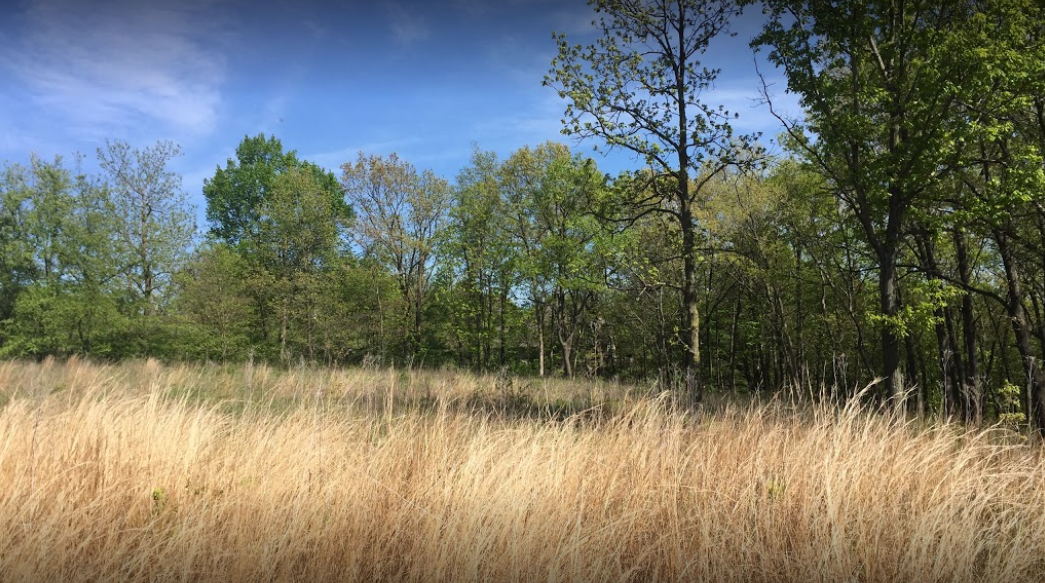
Ridgetop Hill Nature Preserve in Illinois. Site of an overnight field trip in the Ancient (personal) History of this blogger!
The Suit: For Deal Me In 2020, ♥♥♥Hearts♥♥♥ is my Suit for Books I picked up at the 2019 Holiday Author Fair a the Indiana History Center. This suit is also the only suit where I have some short non-fiction pieces (4 of them). This is one of them.
The Author: Ray Boomhower – a prolific author of books about all things Indiana, particularly history and biographies. I’ve read several of his books in the past, biographies of Gus Grissom, General Lew Wallace, and Ernie Pyle.
The Story: “A Voyage Against War (May Wright Sewall and the Ford Peace Ship)” from Boomhower’s book “Indiana Originals,” which contains essays about 40 luminaries of the Hoosier state. For Deal Me In 2020, I picked four of the stories that were about famous Indiana Women.
A Voyage Against War (May Wright Sewall and the Ford Peace Ship)
“I was particularly interested in the university students,” she said, “who, although it was their holiday week, called in great numbers. I was amazed by both the intelligence,and by the lively interest in serious subjects of these young people, whom I was mentally comparing with my young countrymen and countrywomen of student age to the distinct advantage of the latter.”
I like it when my Deal Me In reading leads me to learning new things. Last week, it was the discovery of Russian Mathematician, Sophia Kovalevsky. This week, I learned about the “Ford Peace Ship” (I don’t recall knowing about it before, unless it was one of those cases of hearing about something in passing and not remembering). Organized by automaker Henry Ford and including roughly 60 delegates he invited, the Peace Ship (the Scandinavian-American Line’s “S.S. Oscar II” pictured at left) was an effort to strengthen the dialogue for peace and help move Europe – embroiled in war between the Allied powers and the Central powers – toward ending World War I (which the U.S. hadn’t even entered by the time the voyage took place). When reading about this event, I admit my first thought was, “Well, that’s certainly a naive enterprise!” and you can imagine that many of their contemporaries saw the voyage as a waste of time (see also, for example, the political cartoons at the bottom of this post).
The voyage first stopped in Oslo, but spent considerable time in Stockholm, where they had apparently a busy schedule, and later the Netherlands. I’m not sure if the voyage can be counted a success in tangible measures, but Wright Sewall and others disagreed, saying “To have advanced its (peace’s) arrival by one hour is adequate compensation for the the cost in money, time and sacrifices of the the Expedition if multiplied a thousandfold.” I think their best success probably was in “initiating dialog” and so forth, which regrettably often moves change forward more slowly than other factors.
What about you? Had you heard of this episode of early 20th Century U.S. History? If YOU could dispatch a ship on a Peace Voyage today, for what destination would you set its course? It just occurred to me that perhaps young climate activist Greta Thunberg’s recent voyage is a kind of a modern day Peace Voyage. What do you think?
Deal Me In Coincidence of the Week? This week marked my home state of Indiana’s 100th Anniversary of Women (finally!) gaining the right to vote – another cause which May Wright Sewall was deeply involved in.
Next week for Deal Me In 2020 – Larry Sweazy’s “The Prairie Fire”
Below: The subject of this essay also helped found the Indianapolis Propylaeum, about a 30-minute walk from Deal Me In Headquarters. (I was going to walk over there today and take a picture, but with sub-zero wind chills this morning, I found a google image instead 🙂 )
During my internet ‘research’ for this post, I also stumbled upon this puzzle, which I now want. 🙂 (Suffrage puzzle sold by Uncommon Goods.)
Below: Henry Ford. Unfortunately, poor health led him to turn around and come home just after the peace ship reached Europe.
If I investigate this event in history further, it may be via reading the book below:
Political cartoonists had a field day with the voyage, seeing what they believed to be an easy target for ridicule.
The Card:♦King♦ of Diamonds. (image from Pinterest)
The Suit: For Deal Me In 2020, ♦♦♦Diamonds♦♦♦ is my Suit for “Favorite Female Authors,” and I’m reading from three collections – Margaret Atwood’s “Dancing Girls,” Daphne Du Maurier’s “The Birds and Other Stories,” and Alice Munro’s “Too Much Happiness”
The Author: Alice Munro (one of the world’s most acclaimed short story writers). I’ve blogged about a few stories of hers before, some as part of prior years’ Deal Me In: “Amundsen“, “Some Women“, “Axis“, and “Menesetung.” I liked all of them but Axis may have been my favorite. Picture from nobelprize.org. Yeah, she won one of those for literature. 🙂
The Story: “Too Much Happiness” from her short story collection of the same name. I own a kindle version, er, “license” of this book. I had originally intended to read 4 novella-length “short stories” for Deal Me In this year, assigning them to the nines in my short story deck (‘it’s “Nine for Novella” this week at Deal Me In’ blah blah blah) , but in the end I only included two.
“Always remember that when a man goes out of the room, he leaves everything in it behind,” her friend Marie Mendelson has told her. “When a woman goes out she carries everything that happened in the room along with her.”
Witty quotations like the above point out that there may be, of course, differences between men and women in the way they view the world or think or act. But, where there shouldn’t be differences is in regards to the amount of opportunity available to either sex. This nearly novella length story led me down a rabbit hole of discovery, learning about “the most famous woman scientist before the 20th century,” Sophia Kovalevskaya (pictured below), who struggled against the prejudices of her time, yet achieved much in her too-short life.
I’ve been a fan of Alice Munro for a long time and haven’t read a bad story by her yet. I’m ashamed to say I hadn’t heard of Sophia Kovalevsky before this year (See the Wikipedia page about Kovalevskaya at https://en.wikipedia.org/wiki/Sofya_Kovalevskaya). I also wish I had known the historical background for story before I started reading, since by hopping around and using flashbacks I was left a little confused. What still shone through, however, was the story of an exceptional woman who, through her determination, began to blaze a trail that many others would follow – and are still following today (Even now, I am often reading or hearing about the under-representation of women in the STEM fields). Her resolve in the face of the obstacles of her time should be inspiring to all, women and men.
Another quotation from the story which I found interesting was the following (and my kindle tells me it has been highlighted by a great many of the book’s readers):
“She was learning, quite late, what many people around her appeared to have known since childhood – that life can be perfectly satisfying without major achievements. It could be brimful of occupations which did not weary you to the bone. Acquiring what you needed for a comfortably furnished life, and then to take on a social and public life of entertainment, would keep you from even being bored or idle, and would make you feel at the end of the day that you had done exactly what pleased everybody. There need be no agonizing.
For my part, however, I almost feel that those born with a special talent cannot find solace in this approach, since that very talent almost demands of them that they “see it through.” I think that Sophia is driven in this way.
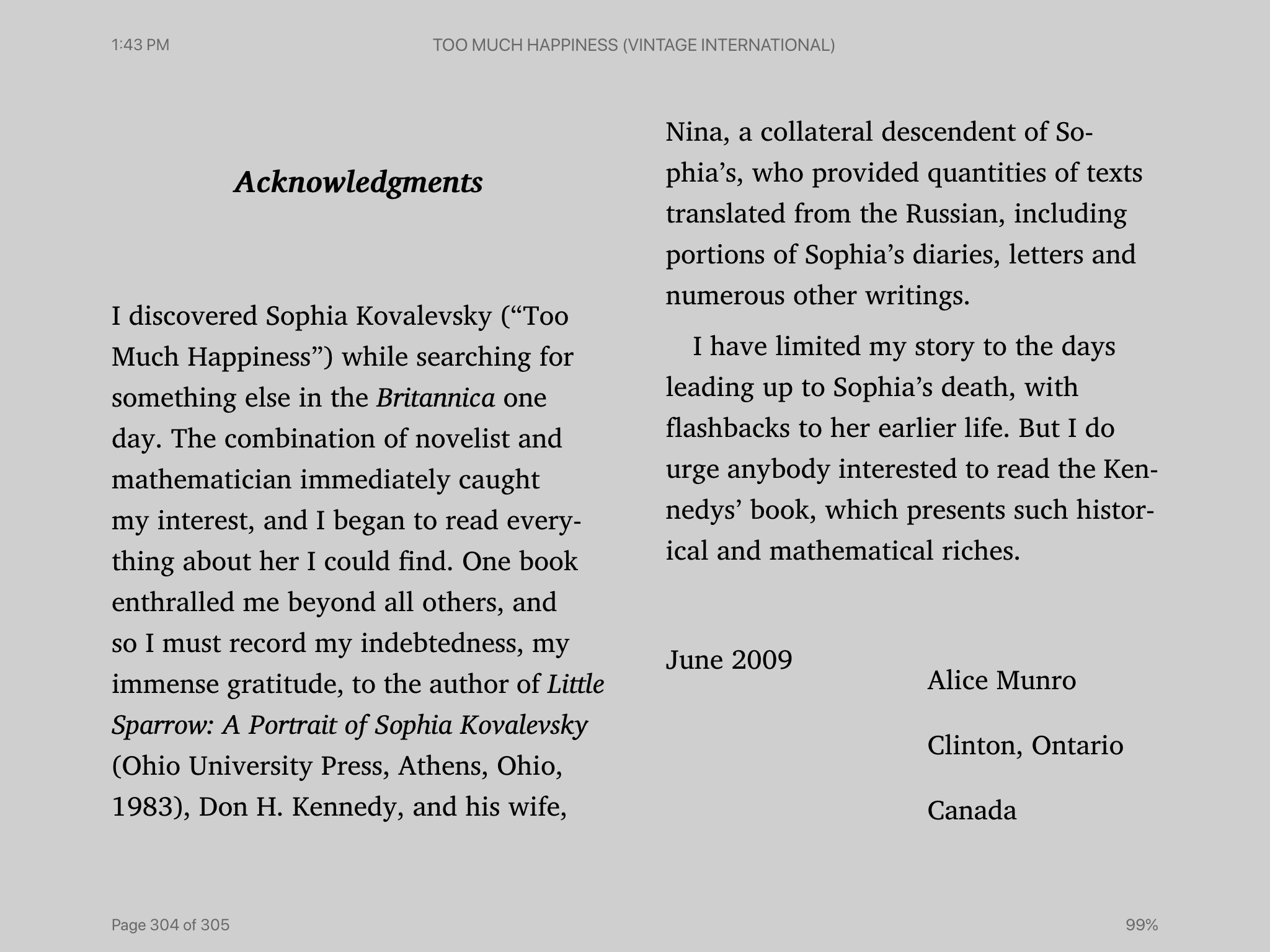
Here’s a copy of Munro’s acknowledgements page about this story, screenshotted from my kindle app. I always enjoy reading about the genesis of stories…
I couldn’t find this story available online anywhere, but if you’re a Munro fan, the book is worth picking up. I was also inspired by this reading to update my donation via amazon.smile for 2020 to the Association of Women in Mathematics. Why not do the same? See this link to point you where to go https://awm-math.org/
What about you? Had you heard of this woman before? (Be honest) This week’s “Deal Me In Coincidence?” (almost) – Kovalevsky’s birthday is January 15th. Just missed it by a few days. 🙂
Next up for Deal Me In 2020: Ray Boomhower’s “A Voyage Against War (May Wright Sweall and the Ford Peace Ship)”
You know when you’ve made it onto a Soviet stamp, you’re a pretty big deal in the C.C.C.P!
Below: A serene final resting place for a brilliant mind…
The Card: ♠Five♠ of Spades (image found on Pinterest)
The Suit:For Deal Me In 2020, ♠♠♠Spades♠♠♠ is my Suit for “darker” stories. Loosely defined this year as Science Fiction, Mysteries, and those from an Alfred Hitchcock anthology.
The Author:Agatha Christie (you may have heard of her 🙂). I actually haven’t read THAT much by her. One of my book clubs read her classic mystery “And Then There Were None” (a.k.a. Ten Little Indians, which was how a paperback version I read when I was a school kid was titled), and I also blogged about a good short story of hers titled “The Red Signal.” I also remember once Christie was an answer to a “trivia night” question at a local pub I frequent. Something about ‘the English language author who has sold the most books of all time” (I didn’t fact check afterward, but I guess that wouldn’t surprise me.) Photo of a young Agatha found at Wikipedia)
The Story:“The Actress” from her short story collection “The Harlequin Tea Set and other Stories” which I own a kindle version of.
“Her faint, derisive smile was answer enough. Beneath her self-control, though he did not guess it, was the impatience of the keen brain watching a slower brain laboriously cover the ground it had already traversed in a flash.”
I am not necessarily a believer in “luck” or coincidences, but I freely admit to being an entertained observer of their seeming manifestations. Part of the appeal to me of the Deal Me In challenge is the luck of the draw – i.e., why did I draw this particular card for this particular week? (I know the true answer is random chance, but I like to speculate otherwise). Though I thoroughly enjoyed this week’s story, it’s certainly not as deep or thought-provoking as many on my 2020 roster will hopefully be. Yet, I thought it was a perfect story to get me “warmed up” for a new year of Deal Me In. It has the qualities which I’ve admired in other Agatha Christie stories – a tidy, compact rendering with nothing superfluous and everything in its place. I suppose an acclaimed writer of mysteries would find such a style helpful.
This story was first published under a different title – “A Trap for the Unwary” in The Novel Magazine in 1923. I’m not sure when or why its name was changed – perhaps before its inclusion in other collections. Whatever the reason, though, I applaud the change, as the protagonist gets the main billing, which she richly deserves…
Olga Stormer is a stage actress in the process of making a name for herself. We join her in this story as she is “adding yet another triumph to her list of successes as “Cora,” in The Avenging Angel.” Not much of a story yet, though, right? What if I told you Olga Stormer is not her real name (that name would be the plain-sounding “Nancy Taylor”), but that’s still not quite a story, right? I mean many performers take stage names, and one must admit that “Olga Stormer” fires the imagination a little more than “Nancy Taylor.” BUT this character didn’t change her name for her career, she changed it when she went on the run after an incident in her past. A pretty serious incident, actually. When she was a “half-starved little gutter waif,” she says, she “shot a man, a beast of a man who deserved to be shot. The circumstances under which I killed him were such that no jury on earth would have convicted me.” When it happened though, she was “only a frightened kid” and thus ran and has been fleeing her past ever since.
We join the story as a man from her past intrudes upon her present, threatening to reveal her sordid history to her “public” thus ruining her if he is not paid. She discusses how to deal with the threat with her manager (the quotation above is from her interaction with him) and the solution that she comes up with is worth an Academy Award. In which category I’m not sure as it seems she’d be eligible for several. Olga’s execution of her “defense strategy” was clean and seamless and, thus, also entertaining.
What about YOU? Are you an Agatha Christie fan? Are there other short stories of hers that you would recommend? What about mysteries in general? What is your favorite short story mystery?
Next week on #DealMeIn2020: Alice Munro’s “Too Much Happiness”



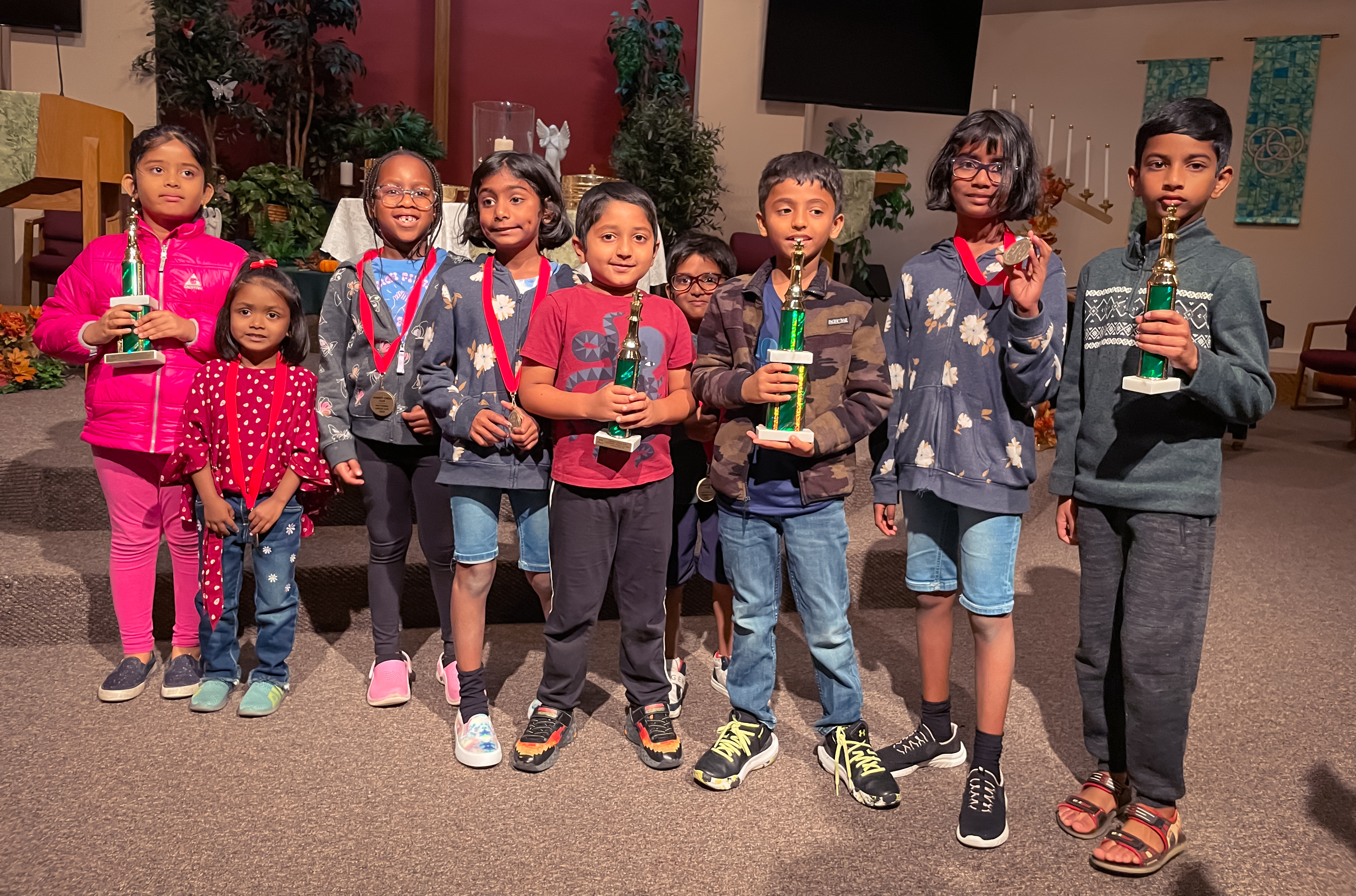 3rd & Under Prizewinners


 vs. Madison Brown; Background: Lauro Alejandra Escobar Lopez








 The Card:
  The Card:


 The Card:



 “I was particularly interested in the university students,” she said, “who, although it was their holiday week, called in great numbers. I was amazed by both the intelligence,and by the lively interest in serious subjects of these young people, whom I was mentally comparing with my young countrymen and countrywomen of student age to the distinct advantage of the latter.”
 the “Ford Peace Ship” (I don’t recall knowing about it before, unless it was one of those cases of hearing about something in passing and not remembering). Organized by automaker Henry Ford and including roughly 60 delegates he invited, the Peace Ship (the Scandinavian-American Line’s “S.S. Oscar II” pictured at left) was an effort to strengthen the dialogue for peace and help move Europe – embroiled in war between the Allied powers and the Central powers – toward ending World War I (which the U.S. hadn’t even entered by the time the voyage took place). When reading about this event, I admit my first thought was, “Well, that’s certainly a naive enterprise!” and you can imagine that many of their contemporaries saw the voyage as a waste of time (see also, for example, the political cartoons at the bottom of this post).


 The Card:


 The Card: ♠Five♠ of Spades


 Bibliophilopolis